
.svg)
Food and Flame in the Sudanese Maseed
At the masid of Sheikh Wad Badr in Um Dawanban, a tale has been passed down through generations telling of Sheikh al-Obeid Wad Badr and the dibliba.


/ answered

Where Bread and Dhikr Meet
At the masid (a religious school and communal space) of Sheikh Wad Badr in Um Dawanban, a tale has been passed down through generations telling of Sheikh al-Obeid Wad Badr and the dibliba. This refers to the staple lump of dough, also known as ‘asida, that is made of sorghum and that has been known for over 170 years. The tale relates to the miracle of how the fire where the dibliba is cooked has never died out, and how the flour to make it has never run out. This remarkable feature of the masid is similar to the way Sudanese takaya (communal kitchens) continue to function. At the masid, the ‘asida is continuously being cooked over the fire and is stirred in a circular motion that echoes the endless chants of dhikr (supplications of God’s names) that reverberate around the courtyard.
Fire is therefore a deeply rooted symbol of Sudanese heritage for both providing food and sustenance, and for the light of the Qur’an and the guidance it provides. Those lighting a fire at night are celebrated for their generosity and hospitality, as in the popular song: ‘Your fire burns till dawn, O ever present Sheikh Wad Badr.’ Fire also represents knowledge in some religious verses:
‘Where is Dishayn, the judge of justice,
Who does not stray from the path of the righteous.
He of pure descent, who kindled the flame of the Message (of Islam).’
Sheikh Al-Obeid Wad Badr himself first settled in Al-Nikhayra, east of Um Dawanban, where he lit the fire known as tuqqāba to teach the Qur’an and honour guests with ‘asida. In Sudan, a tuqqāba refers to an area dedicated to learning the Qur’an, usually located next to, or forming part of, the masid. These were places where students resided, receiving both spiritual and material care. At the time, Sheikh Wad Badr acquired the nickname ‘Awaj al-Darib’ meaning ‘the one who diverted the path’ because he would spend the rainy season in Al-Nikhayra cultivating sorghum, and then in the summer, he would move to Um Dawanban where he eventually settled and founded the masid that would later flourish.
The ‘asida that has been cooked at the masid since those early days, became known as the dibliba. After the sorghum was ground and prepared, it was cooked on a large iron griddle or sāj, then it was divided with a wooden blade into equal portions and served in carved wooden bowls with yoghurt or beans. People would come to eat the dibliba but to also receive the blessings of the ritual.
Sheikh Wad Badr often linked food with the spiritual, urging his disciples to feed others as a way to bring them closer to the divine; ‘Give a morsel, measure your words, do not be stern, and before daybreak rise to see if anyone is hungry’ was one of his sayings. ‘Give money, spread the seating mat, feed the hungry and see how people will gather around you,’ was another. Yet another went ‘whoever has no love, has nothing,’ and ‘blessed is the one who performs his night prayer and shares his supper and who rises before dawn to offer a humble prayer to his Lord.’
The dibliba, or ‘asida, is known by different names in other masid. For example al-muhayba or Allahallah and is used to describe the food of the murīdīn (devotees, Qur’an scholars, disciples and ascetics). While this staple food is shunned by wealthy or arrogant people, in the eyes of the murīdīn it is blessed and provides source of healing, and is a humbling experience for the community. In devotional chants it is described as such:
‘The lalūba (Balanites aegyptiaca, whose wood is used to make the paddle and bowl receptacle and whose stones are threaded onto a sibha to form prayer beads and evokes spiritual endurance and nocturnal devotion.)
By night it’s servants chant.
The lalūba, O lalūba,
O what an honourable ritual,
Not only is it food, but a rite of love,
A balm for the soul, a quiet teacher of humility.
Those youth who seek it unveil the mystery, taste its fruit and drink from its hidden treasures.’

From the masid of Sheikh Wad Badr, the tale extends to other masids and khalāwī across Sudan, where these meanings are continually replicated with only minor differences. The masid is bound to the land and to farming: the sheikh and his students cultivate the adjoining fields planting sorghum, harvesting it, and storing it in the makhzan al-mīra (provisions storehouse). Each evening the sorghum is ground, and the Khalīfa himself oversees the food, from the emergence of raw materials from the storehouse, to the moment it is served. It is a never-ending daily cycle, a rhythm of labour, devotion, and care.
At the heart of Sudanese Sufi life, food is never separate from dhikr just as fire is accompanied by light. In one corner of the masid, verses of the Qur’an are recited, in another, the fire of the dibliba burns. It is a flame that glows beneath the pots of ‘asida, just as it glows within the hearts of the devotees. It sustains the ḥīrān (students and followers) body and soul alike. This fire burns throughout the year, as if in a never-ending prayer, and has become the defining emblem of Sheikh Wad Badr’s way of teaching the Qur’an and educating his students.
The fire of the masid not only illuminates the world around it, it creates an entire system of economic, spiritual, and social solidarity where the student is nourished by the yield of his own labour and the guest eats from the communal platter. The wealthy bestow karāma, or charitable offerings, upon the ḥīrān and grain is sometimes taken to homes in the village where it is cooked and returned to the masid, accompanied by prayers of blessing. These practices intersect with the ideals of communal protection and independence from the market, forming an enduring safety net even in times of crisis and war.
When Souls Are Nurtured by the Fire of Kisra
In the masid, a dedicated group of workers gathers firewood, flour, and food. The students themselves clear the rough ground, sow it with sorghum, and store the harvest. This crop serves as a vital support for the masid’s communal kitchen known as takiyya.
In the kitchen, a group of women both young and old, work with quiet intensity to prepare food for the students, as an act of devotion to get closer to God. Here, food is not a domestic chore but part of a collective pedagogy, where spiritual and practical values are nurtured together. The ḥīrān share these responsibilities according to how long they have been at the masid. Thus, newcomers gather firewood and clean pots, while the more advanced move on to ʿiwāsa (stirring the sorghum porridge), cooking ʿ’asida, and preparing drinks such as ḥilū mur and abray abyad.
The preparation of dibliba is an elaborate communal ritual and is a process that is repeated throughout the day, with the masid consuming between 10 and 30 sacks of flour daily to feed over 1,500 students and visitors.
Male students also contribute by building ovens, cleaning the food courtyards, and transporting meals in orderly rows in a display of discipline and cooperation. This collective system is called al-‘ammār, and has a daily schedule where duties are carefully divided out and food is not only sustenance, but a ritual practice, creating a sense of belonging and deepening ties between student and place, individual and community.
Women from the village and surrounding areas also contribute to food preparation—especially in the Bayt al-Ṭayyāb (House of Cooking), where fatta and ‘asida are prepared and tables are laid out for special occasions. The Khalīfa or Sheikh oversees the coordination between the groups, taking into account the age and rank of the members. Each movement to prepare the food is seen as part of the process of tazkiya or the purification of the soul. Every meal served is regarded as ṣadaqa jāriya an ongoing charity in the community’s shared ledger of good deeds.
When the Takiyya Is Lit in Times of War
In Sudan, the takiyya is not merely a place for preparing food, it is also a social and spiritual institution, deeply rooted in collective memory. Historically, it took form within the masids and khalāwī and was always associated with the rings of dhikr and Qur’anic teaching.
This fire of the masid has, over time, been transformed from its traditional representation into more flexible, responsive manifestations, especially in times of disaster. After the outbreak of war in Sudan in April 2023 and as supply chains collapsed and markets ground to a halt and the state fell into paralysis, emergency kitchens known as neighbourhood takiyya initiatives, emerged across many districts of the capital Khartoum, and its outskirts. They were collective, community-driven efforts to provide food for the displaced and affected residents.
These kitchens were established in diverse locations. Some emerged within the courtyards of old masids, where traditional spaces were revived such as the masid of Sheikh al-Yaqout and the masid of Abu Qurun. There, the old Bayt al-Ṭayyāb and granaries were repurposed to prepare food for the displaced. However, the vast majority of kitchens were established from scratch; two pots and a bundle of firewood built by neighbourhood women and youth from the resistance committees. They sprang up in public squares, inside schools transformed into shelters, and even within volunteers’ homes. In these kitchens, cooking was not merely a biological act but one of resistance, a preservation of dignity. Women and youth prepared food with the same intention that once animated the masid: the spirit of the collective, support of the vulnerable and feeding the hungry with dignity. As in the past, when the takiyya was rooted in the land sustained by fields and harvest seasons and guided by the spiritual leadership of the Sheikh, in times of war, the land changed, and the harvest disappeared but the spirit of the act remained.
Support now comes in the form of remittances from those abroad, in-kind donations, and digital campaigns of solidarity. Yet the fire still burns, and the intention lives on. Within the emergency kitchens, as in the old takiyyas, an elaborate system of labour division emerged and tasks were typically assigned according to capacity and availability. Women bore the main responsibility for cooking, while men managed the procurement of supplies from markets, fetched water, and secured gas or firewood at a time of extreme scarcity. Young people of all genders joined in distributing meals and organising queues.
These kitchens were not merely relief initiatives. They reimagined the principle of the takiyya in a contemporary context, where preparing food became a collective act—an expression of resilience. What was once a domestic task was transformed into a communal practice with long-standing rituals. Despite their simplicity, these kitchens were able to sustain a network of mutual support that withstood the collapse of markets and scarcity of resources and demonstrated that there was no need for bureaucratic structures. Trust and local knowledge were enough to organize the work just as it was in the masid, where much was accomplished with little, where fire became a sign of life, and cooking was a prayer to stave off hunger.
When Fire Becomes Prayer
In a country besieged by recurring crises, where war extinguishes light, the fire of the masid continues to burn not only as a form of miracle but as a sign of life. From the dibliba simmering in Sheikh Wad Badr’s courtyard to the pot of balīla beans in an emergency kitchen in a crumbling neighbourhood of Khartoum, the flame is passed on not only through firewood, but through what cannot be seen: intention, love, and certainty. The takiyya was never only a kitchen for distributing food, it was a space where dhikr met labour; where hunger was dissolved in the generosity of the collective. When the siege tightened and Khartoum burned, the takiyya returned to offer salvation. Emergency kitchens became a living extension of that legacy, where people gathered around the fire to eat and to preserve what remained of their humanity. Women’s kind act of lighting fires was carried in the bodies of all the followers and anyone came from the wilderness to seek its warm blessing. With every ladle of food, a memory was revived, that of a fire that never dies, and a spirit that is never broken.
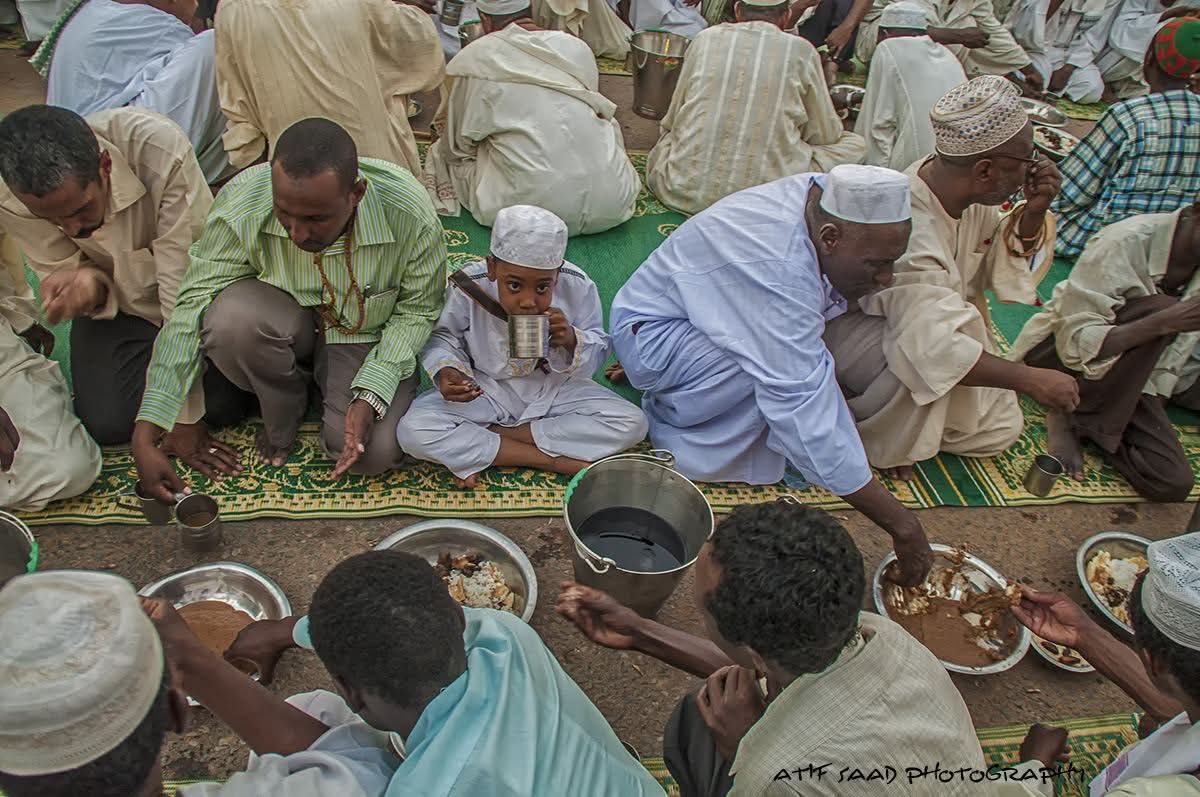
Cover picture taken by Atif Saad
References
- Al-Tayyib, M. T. (2005). Al-Masid [المسيد]. Khartoum: Dar ‘Azza for Publishing and Distribution.
- Aksis Design and Promotion. (2017, December). Al-At‘ima al-Taqsiyya [الأطعمة الطقسية]. Madhāq Khāṣ Magazine, Issue 1.
- Abu ‘Aqilah, M. F. Y. (2015, August). Mafāhīm ḥawla al-aṭ‘ima al-taqlīdiyya fī Ṭabaqāt Wad Ḍayf Allāh [مفاهيم حول الأطعمة التقليدية في طبقات ود ضيف الله]. In Conference on the Book of Ṭabaqāt Wad Ḍayf Allāh (Sennar: Capital of Islamic Culture 2017). University of Khartoum.
- Ḍayf Allāh, M. D. al-Ja‘alī al-Faḍlī. (2009). Kitāb al-Ṭabaqāt: Fī khuṣūṣ al-awliyā’ wa al-ṣāliḥīn wa al-‘ulamā’ wa al-shu‘arā’ fī al-Sūdān [كتاب الطبقات]. Khartoum: Sudanese Book House.
- ‘Uthmān, ‘A. R. A. (2004). Al-Ṣūfiyya fī al-Sūdān: Muḥaddidāt thaqāfiyya wa aw‘iyat lil-‘amal al-ijtimā‘ī [الصوفية بالسودان]. Khartoum: Africa International University Press.
- ‘Abd al-Salām, Sh. al-Amīn, translated by Y. Ḥ. Madanī & M. al-Mahdī Bushrā, edited by al-Amīn Abū Munqa. (2007). Karāmāt al-awliyā’: Dirāsa fī siyāqihā al-ijtimā‘ī wa al-thaqāfī [كرامات الأولياء]. Khartoum: Institute of African and Asian Studies.
- ‘Abd Allāh, ‘U. M. (2023). Oral interview. Member of the Al-Jarīf West Neighborhood Committee.
Where Bread and Dhikr Meet
At the masid (a religious school and communal space) of Sheikh Wad Badr in Um Dawanban, a tale has been passed down through generations telling of Sheikh al-Obeid Wad Badr and the dibliba. This refers to the staple lump of dough, also known as ‘asida, that is made of sorghum and that has been known for over 170 years. The tale relates to the miracle of how the fire where the dibliba is cooked has never died out, and how the flour to make it has never run out. This remarkable feature of the masid is similar to the way Sudanese takaya (communal kitchens) continue to function. At the masid, the ‘asida is continuously being cooked over the fire and is stirred in a circular motion that echoes the endless chants of dhikr (supplications of God’s names) that reverberate around the courtyard.
Fire is therefore a deeply rooted symbol of Sudanese heritage for both providing food and sustenance, and for the light of the Qur’an and the guidance it provides. Those lighting a fire at night are celebrated for their generosity and hospitality, as in the popular song: ‘Your fire burns till dawn, O ever present Sheikh Wad Badr.’ Fire also represents knowledge in some religious verses:
‘Where is Dishayn, the judge of justice,
Who does not stray from the path of the righteous.
He of pure descent, who kindled the flame of the Message (of Islam).’
Sheikh Al-Obeid Wad Badr himself first settled in Al-Nikhayra, east of Um Dawanban, where he lit the fire known as tuqqāba to teach the Qur’an and honour guests with ‘asida. In Sudan, a tuqqāba refers to an area dedicated to learning the Qur’an, usually located next to, or forming part of, the masid. These were places where students resided, receiving both spiritual and material care. At the time, Sheikh Wad Badr acquired the nickname ‘Awaj al-Darib’ meaning ‘the one who diverted the path’ because he would spend the rainy season in Al-Nikhayra cultivating sorghum, and then in the summer, he would move to Um Dawanban where he eventually settled and founded the masid that would later flourish.
The ‘asida that has been cooked at the masid since those early days, became known as the dibliba. After the sorghum was ground and prepared, it was cooked on a large iron griddle or sāj, then it was divided with a wooden blade into equal portions and served in carved wooden bowls with yoghurt or beans. People would come to eat the dibliba but to also receive the blessings of the ritual.
Sheikh Wad Badr often linked food with the spiritual, urging his disciples to feed others as a way to bring them closer to the divine; ‘Give a morsel, measure your words, do not be stern, and before daybreak rise to see if anyone is hungry’ was one of his sayings. ‘Give money, spread the seating mat, feed the hungry and see how people will gather around you,’ was another. Yet another went ‘whoever has no love, has nothing,’ and ‘blessed is the one who performs his night prayer and shares his supper and who rises before dawn to offer a humble prayer to his Lord.’
The dibliba, or ‘asida, is known by different names in other masid. For example al-muhayba or Allahallah and is used to describe the food of the murīdīn (devotees, Qur’an scholars, disciples and ascetics). While this staple food is shunned by wealthy or arrogant people, in the eyes of the murīdīn it is blessed and provides source of healing, and is a humbling experience for the community. In devotional chants it is described as such:
‘The lalūba (Balanites aegyptiaca, whose wood is used to make the paddle and bowl receptacle and whose stones are threaded onto a sibha to form prayer beads and evokes spiritual endurance and nocturnal devotion.)
By night it’s servants chant.
The lalūba, O lalūba,
O what an honourable ritual,
Not only is it food, but a rite of love,
A balm for the soul, a quiet teacher of humility.
Those youth who seek it unveil the mystery, taste its fruit and drink from its hidden treasures.’
From the masid of Sheikh Wad Badr, the tale extends to other masids and khalāwī across Sudan, where these meanings are continually replicated with only minor differences. The masid is bound to the land and to farming: the sheikh and his students cultivate the adjoining fields planting sorghum, harvesting it, and storing it in the makhzan al-mīra (provisions storehouse). Each evening the sorghum is ground, and the Khalīfa himself oversees the food, from the emergence of raw materials from the storehouse, to the moment it is served. It is a never-ending daily cycle, a rhythm of labour, devotion, and care.
At the heart of Sudanese Sufi life, food is never separate from dhikr just as fire is accompanied by light. In one corner of the masid, verses of the Qur’an are recited, in another, the fire of the dibliba burns. It is a flame that glows beneath the pots of ‘asida, just as it glows within the hearts of the devotees. It sustains the ḥīrān (students and followers) body and soul alike. This fire burns throughout the year, as if in a never-ending prayer, and has become the defining emblem of Sheikh Wad Badr’s way of teaching the Qur’an and educating his students.
The fire of the masid not only illuminates the world around it, it creates an entire system of economic, spiritual, and social solidarity where the student is nourished by the yield of his own labour and the guest eats from the communal platter. The wealthy bestow karāma, or charitable offerings, upon the ḥīrān and grain is sometimes taken to homes in the village where it is cooked and returned to the masid, accompanied by prayers of blessing. These practices intersect with the ideals of communal protection and independence from the market, forming an enduring safety net even in times of crisis and war.
When Souls Are Nurtured by the Fire of Kisra
In the masid, a dedicated group of workers gathers firewood, flour, and food. The students themselves clear the rough ground, sow it with sorghum, and store the harvest. This crop serves as a vital support for the masid’s communal kitchen known as takiyya.
In the kitchen, a group of women both young and old, work with quiet intensity to prepare food for the students, as an act of devotion to get closer to God. Here, food is not a domestic chore but part of a collective pedagogy, where spiritual and practical values are nurtured together. The ḥīrān share these responsibilities according to how long they have been at the masid. Thus, newcomers gather firewood and clean pots, while the more advanced move on to ʿiwāsa (stirring the sorghum porridge), cooking ʿ’asida, and preparing drinks such as ḥilū mur and abray abyad.
The preparation of dibliba is an elaborate communal ritual and is a process that is repeated throughout the day, with the masid consuming between 10 and 30 sacks of flour daily to feed over 1,500 students and visitors.
Male students also contribute by building ovens, cleaning the food courtyards, and transporting meals in orderly rows in a display of discipline and cooperation. This collective system is called al-‘ammār, and has a daily schedule where duties are carefully divided out and food is not only sustenance, but a ritual practice, creating a sense of belonging and deepening ties between student and place, individual and community.
Women from the village and surrounding areas also contribute to food preparation—especially in the Bayt al-Ṭayyāb (House of Cooking), where fatta and ‘asida are prepared and tables are laid out for special occasions. The Khalīfa or Sheikh oversees the coordination between the groups, taking into account the age and rank of the members. Each movement to prepare the food is seen as part of the process of tazkiya or the purification of the soul. Every meal served is regarded as ṣadaqa jāriya an ongoing charity in the community’s shared ledger of good deeds.
When the Takiyya Is Lit in Times of War
In Sudan, the takiyya is not merely a place for preparing food, it is also a social and spiritual institution, deeply rooted in collective memory. Historically, it took form within the masids and khalāwī and was always associated with the rings of dhikr and Qur’anic teaching.
This fire of the masid has, over time, been transformed from its traditional representation into more flexible, responsive manifestations, especially in times of disaster. After the outbreak of war in Sudan in April 2023 and as supply chains collapsed and markets ground to a halt and the state fell into paralysis, emergency kitchens known as neighbourhood takiyya initiatives, emerged across many districts of the capital Khartoum, and its outskirts. They were collective, community-driven efforts to provide food for the displaced and affected residents.
These kitchens were established in diverse locations. Some emerged within the courtyards of old masids, where traditional spaces were revived such as the masid of Sheikh al-Yaqout and the masid of Abu Qurun. There, the old Bayt al-Ṭayyāb and granaries were repurposed to prepare food for the displaced. However, the vast majority of kitchens were established from scratch; two pots and a bundle of firewood built by neighbourhood women and youth from the resistance committees. They sprang up in public squares, inside schools transformed into shelters, and even within volunteers’ homes. In these kitchens, cooking was not merely a biological act but one of resistance, a preservation of dignity. Women and youth prepared food with the same intention that once animated the masid: the spirit of the collective, support of the vulnerable and feeding the hungry with dignity. As in the past, when the takiyya was rooted in the land sustained by fields and harvest seasons and guided by the spiritual leadership of the Sheikh, in times of war, the land changed, and the harvest disappeared but the spirit of the act remained.
Support now comes in the form of remittances from those abroad, in-kind donations, and digital campaigns of solidarity. Yet the fire still burns, and the intention lives on. Within the emergency kitchens, as in the old takiyyas, an elaborate system of labour division emerged and tasks were typically assigned according to capacity and availability. Women bore the main responsibility for cooking, while men managed the procurement of supplies from markets, fetched water, and secured gas or firewood at a time of extreme scarcity. Young people of all genders joined in distributing meals and organising queues.
These kitchens were not merely relief initiatives. They reimagined the principle of the takiyya in a contemporary context, where preparing food became a collective act—an expression of resilience. What was once a domestic task was transformed into a communal practice with long-standing rituals. Despite their simplicity, these kitchens were able to sustain a network of mutual support that withstood the collapse of markets and scarcity of resources and demonstrated that there was no need for bureaucratic structures. Trust and local knowledge were enough to organize the work just as it was in the masid, where much was accomplished with little, where fire became a sign of life, and cooking was a prayer to stave off hunger.
When Fire Becomes Prayer
In a country besieged by recurring crises, where war extinguishes light, the fire of the masid continues to burn not only as a form of miracle but as a sign of life. From the dibliba simmering in Sheikh Wad Badr’s courtyard to the pot of balīla beans in an emergency kitchen in a crumbling neighbourhood of Khartoum, the flame is passed on not only through firewood, but through what cannot be seen: intention, love, and certainty. The takiyya was never only a kitchen for distributing food, it was a space where dhikr met labour; where hunger was dissolved in the generosity of the collective. When the siege tightened and Khartoum burned, the takiyya returned to offer salvation. Emergency kitchens became a living extension of that legacy, where people gathered around the fire to eat and to preserve what remained of their humanity. Women’s kind act of lighting fires was carried in the bodies of all the followers and anyone came from the wilderness to seek its warm blessing. With every ladle of food, a memory was revived, that of a fire that never dies, and a spirit that is never broken.
Cover picture taken by Atif Saad
References
- Al-Tayyib, M. T. (2005). Al-Masid [المسيد]. Khartoum: Dar ‘Azza for Publishing and Distribution.
- Aksis Design and Promotion. (2017, December). Al-At‘ima al-Taqsiyya [الأطعمة الطقسية]. Madhāq Khāṣ Magazine, Issue 1.
- Abu ‘Aqilah, M. F. Y. (2015, August). Mafāhīm ḥawla al-aṭ‘ima al-taqlīdiyya fī Ṭabaqāt Wad Ḍayf Allāh [مفاهيم حول الأطعمة التقليدية في طبقات ود ضيف الله]. In Conference on the Book of Ṭabaqāt Wad Ḍayf Allāh (Sennar: Capital of Islamic Culture 2017). University of Khartoum.
- Ḍayf Allāh, M. D. al-Ja‘alī al-Faḍlī. (2009). Kitāb al-Ṭabaqāt: Fī khuṣūṣ al-awliyā’ wa al-ṣāliḥīn wa al-‘ulamā’ wa al-shu‘arā’ fī al-Sūdān [كتاب الطبقات]. Khartoum: Sudanese Book House.
- ‘Uthmān, ‘A. R. A. (2004). Al-Ṣūfiyya fī al-Sūdān: Muḥaddidāt thaqāfiyya wa aw‘iyat lil-‘amal al-ijtimā‘ī [الصوفية بالسودان]. Khartoum: Africa International University Press.
- ‘Abd al-Salām, Sh. al-Amīn, translated by Y. Ḥ. Madanī & M. al-Mahdī Bushrā, edited by al-Amīn Abū Munqa. (2007). Karāmāt al-awliyā’: Dirāsa fī siyāqihā al-ijtimā‘ī wa al-thaqāfī [كرامات الأولياء]. Khartoum: Institute of African and Asian Studies.
- ‘Abd Allāh, ‘U. M. (2023). Oral interview. Member of the Al-Jarīf West Neighborhood Committee.


.jpg)


